Τούρκοι και Αλβανοί σκάβουν, σκάβουν, σκάβουν συνέχεια και ολο ελληνικά αγάλματα, κολώνες, αγγεία και νομίσματα βρίσκουν
~~~~~~~~~~~~~~~~~~~~~~~~~~~~~~~~~~~~
Οι Τούρκοι τα βαφτίζουν «ρωμαϊκά», οι Αλβανοί «Ιλλυρικά».
Αλλα η γλώσσα, η τεχνοτροπία, η χρονολόγηση τους διαψεύδει και τους δύο.
Έτσι, το σύμπλεγμα κατωτερότητας διογκώνεται.
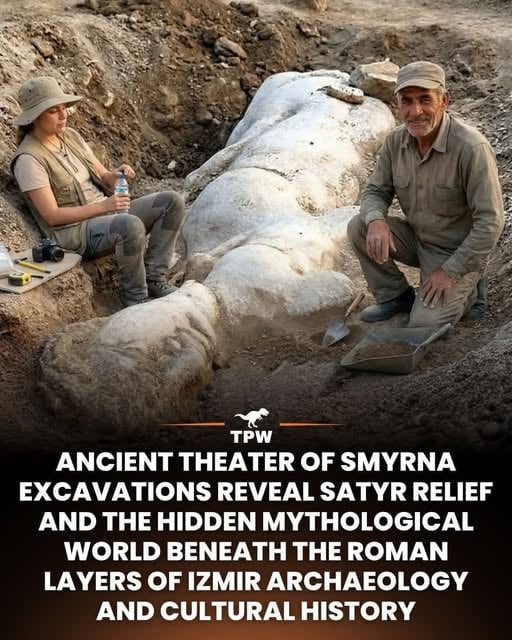
Ένα ακομα ελληνικό άγαλμα ανακαλύφθηκε στη Σμύρνη
(Για τους Σκοπιανούς μη ρωτάτε. Δεν βρίσκουν τίποτα. Εξάλλου πάνω από τη γραμμή Αχρίδα – Μοναστήρι – Γευγελή – Μελένικο δεν ήταν Μακεδονία. Αντε κανένα νόμισμα να βρεθεί του Μεγάλου Αλεξάνδρου ή του Φιλίππου).
Αντιγράφω την εξής ανάρτηση
https://www.facebook.com/share/p/1EY11FhRE8
Beneath the modern city of Izmir lies a buried world where stone once spoke the language of myth, performance, and ancient civic life.
The ongoing archaeological excavations at the ancient theater of Smyrna have brought to light remarkable details that deepen our understanding of life in one of the most important cities of the ancient Aegean world. Smyrna, known today as Izmir in Türkiye, was a thriving cultural and commercial hub during Greek, Hellenistic, and Roman periods. The theater itself stands as one of its most enduring monuments, used continuously for approximately 700 years before being gradually abandoned in the 4th century AD as the Roman world transitioned into late antiquity.
Among the most significant discoveries is a finely carved relief of a satyr, a mythological creature deeply associated with the followers of Dionysus. In ancient tradition, satyrs symbolised revelry, fertility, and the untamed forces of nature, often appearing in theatrical performances that blended humour, tragedy, and ritual storytelling. The relief depicts the satyr holding a lagobolon, a curved hunting club commonly associated with hunting scenes in Greek art, suggesting a fusion of mythological symbolism and everyday cultural motifs.
The presence of such iconography within the theater reinforces its role not only as a place of entertainment but also as a spiritual and social space where mythology and civic identity intersected. The craftsmanship of the relief reflects the artistic sophistication of Smyrna’s sculptors, who integrated local traditions with broader Hellenistic artistic styles.
Excavations in this area continue to reveal layers of construction, renovation, and cultural adaptation, showing how the theater evolved alongside the city itself. Each newly uncovered fragment contributes to a clearer picture of how ancient audiences experienced drama and ritual in a shared communal setting.
Strange yet fascinating fact
Satyrs in ancient Greek culture were often depicted as part human and part animal, yet no consistent animal form was ever agreed upon, making them one of the most visually flexible mythological beings in classical art.
 ΝΕΑ των ΦΙΛΙΑΤΩΝ
Σχολιάστε